
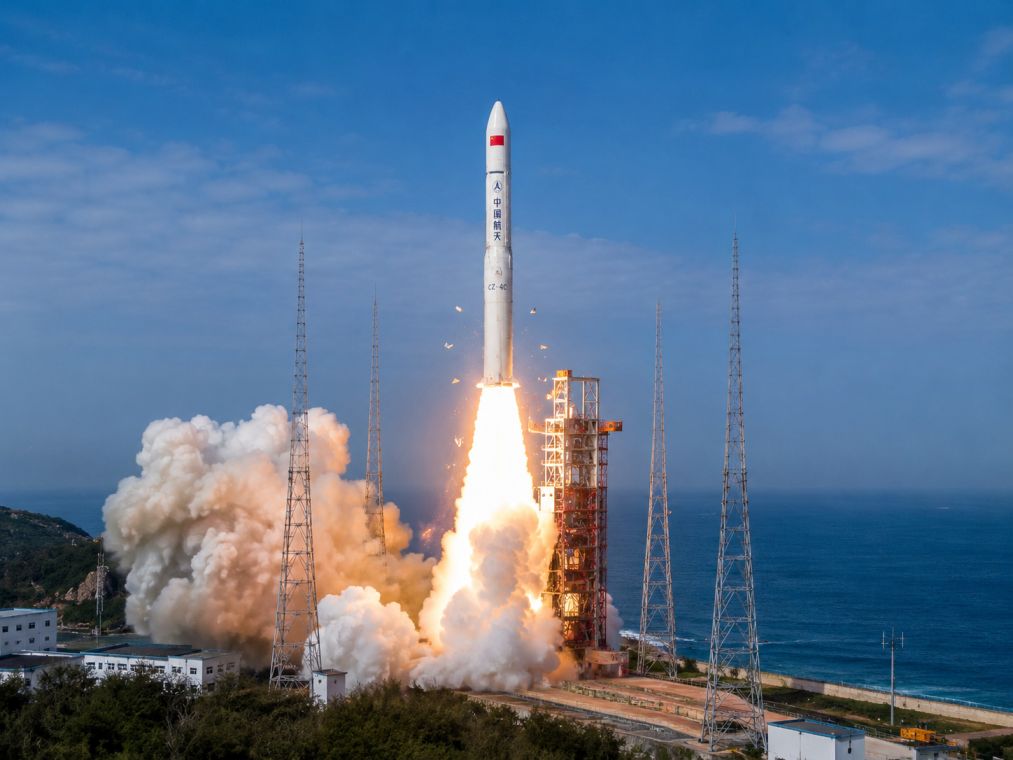
China has advanced its ocean observation and environmental monitoring capabilities with the successful launch of the Haiyang-2E (HY-2E) marine satellite. The satellite was propelled into orbit by a Long March 4B rocket, which took off at 7:46 a.m. Beijing time on Thursday from the Jiuquan Satellite Launch Center in northwest China. This event marked the 654th mission for the Long March rocket series. Developed by the China Academy of Space Technology (CAST), the HY-2E is the latest in the Haiyang-2 series, China’s first satellite network designed for monitoring marine dynamics.
This new satellite is set to replace the HY-2B, which was launched in 2018, and will work alongside the existing HY-2C and HY-2D satellites. Together, this constellation of satellites aims to provide continuous and robust data for marine observation and forecasting services. Equipped with four state-of-the-art microwave remote sensing instruments, the HY-2E will collect comprehensive data on sea surface conditions, including sea surface height, wave height, wind fields, and temperature. This information is crucial for improving marine weather forecasting, climate research, and understanding oceanic phenomena such as El Niño.
Over the last decade, the Haiyang-2 satellite program has been instrumental in disaster prevention, maritime safety, and scientific exploration. The data generated from these satellites supports critical functions such as tracking typhoons, aiding tsunami early warning systems, and enhancing global numerical weather prediction models. Additionally, the observations have been vital for managing marine resources and bolstering national maritime security.
The practical applications of the Haiyang-2 satellite series extend beyond weather and climate studies, offering substantial benefits to the fishing and shipping industries. By providing data on ocean currents, wind, and waves, these satellites help identify lucrative fishing grounds, allowing vessels to optimize their operations and minimize costs. Since the launch of the HY-2B, the satellites have also featured an Automatic Identification System (AIS), which allows for continuous tracking of vessel positions, speeds, and identification details, thereby enhancing navigation safety on congested sea routes.