
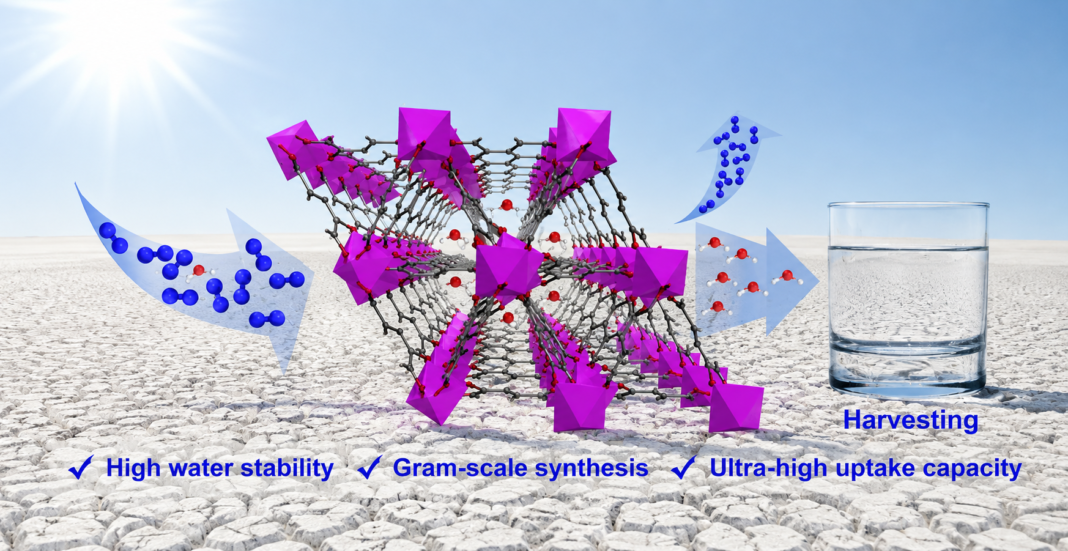
A team of researchers has unveiled a novel metal-organic framework (MOF) that can extract water from the air in extremely dry conditions, potentially revolutionizing water access in arid regions plagued by scarcity. This groundbreaking study highlights the development of gallate-based MOFs constructed from affordable materials such as magnesium, cobalt, and nickel. Notably, the magnesium-based variant, Mg-gallate, outperformed others by capturing an impressive 170 mg of water per gram at a mere 0.2% relative humidity. This achievement represents one of the highest water uptake capacities recorded for porous materials under such low humidity, offering hope for sustainable water solutions in dry areas where existing technologies falter.
The Mg-gallate material demonstrates not only strong water adsorption but also impressive stability. It maintained its structural integrity after 28 days submerged in water and retained effectiveness through 20 adsorption-desorption cycles. Its high selectivity for water molecules, coupled with the ability to exclude nitrogen, makes it a viable candidate for atmospheric water extraction. The material’s performance is attributed to hydrogen bonds between water molecules and oxygen-bearing groups within the MOF’s structure, along with the ultramicroporous channel filling effects. Crucially, this MOF can be manufactured on a gram scale using cost-effective raw materials and standard laboratory processes, signaling its potential for scalable production.
This advancement could significantly enhance atmospheric water harvesting capabilities in deserts and other dry environments. The technology also shows promise for various applications including semiconductor dehumidification, electronics protection, natural gas dehydration, and even space-based water recovery systems. Researchers assert that this gallate-based MOF strategy opens a promising pathway for creating high-performance materials capable of functioning effectively under some of the planet’s driest atmospheric conditions.
The research was spearheaded by Professors Jianji Wang and Huiyong Wang at Henan Normal University in China, with contributions from Rui Zhou, Xueli Ma, Yunlei Shi, Wei Lu, Dazhen Xiong, and Zhiyong Li. The team is known for their expertise in designing porous materials and ionic liquids aimed at addressing energy and environmental challenges. This study contributes to their ongoing efforts to develop practical and scalable atmospheric water harvesting solutions, focusing on materials that can be produced under mild conditions with low-cost precursors.
The findings were published in Green Chemical Engineering, a journal known for its focus on green and sustainable chemistry and chemical engineering. GreenChE aims to disseminate significant research and technological advances, and it is indexed in several databases including ESCI, EI, Scopus, and CSCD. With a notable impact factor, it continues to serve the green chemical engineering community by publishing research of exceptional significance and broad interest.
Legal Disclaimer: The information contained in this article has been provided by independent third-party contributors, clients, or content partners. We do not independently verify the accuracy, completeness, legality, ownership, licensing, or reliability of submitted content, including text, images, videos, trademarks, or other media materials. The submitting party is solely responsible for ensuring that all content, including images and media assets, complies with applicable copyright, trademark, licensing, and intellectual property laws. We disclaim liability for any unauthorized use of copyrighted or proprietary materials by third parties. If you believe that any content published on this platform infringes your intellectual property rights, kindly contact the author above for prompt review and resolution.