
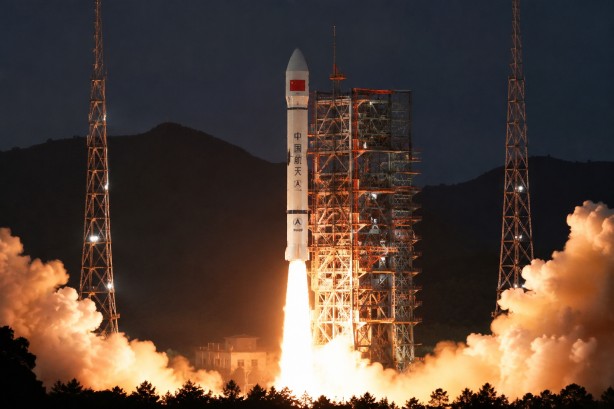
China has successfully launched the Tianlian III-01 data relay satellite, marking a significant step in its expanding space program. The launch took place on Wednesday from the Wenchang Space Launch Center located in Hainan Province. A modified Long March 7 rocket was used to carry the satellite into orbit, with officials confirming that the mission achieved all its intended objectives.
The Tianlian III-01 satellite is designed to enhance China’s space communication capabilities by providing data relay, tracking, and control services. It will play a crucial role in supporting China’s crewed spacecraft, space laboratories, and its space station. Additionally, the satellite is set to assist resource satellites operating in both medium and low Earth orbits.
This mission represents the 659th successful launch in the Long March carrier rocket series, underscoring China’s ongoing commitment to expanding its presence in space. The country continues to develop its technological capabilities, aiming to improve communications and support various space missions.
With the deployment of the Tianlian III-01, China is poised to further its advancements in space infrastructure. The satellite’s capabilities are expected to significantly boost the efficiency and reliability of data transmission for space missions, thereby reinforcing China’s strategic objectives in space exploration.