
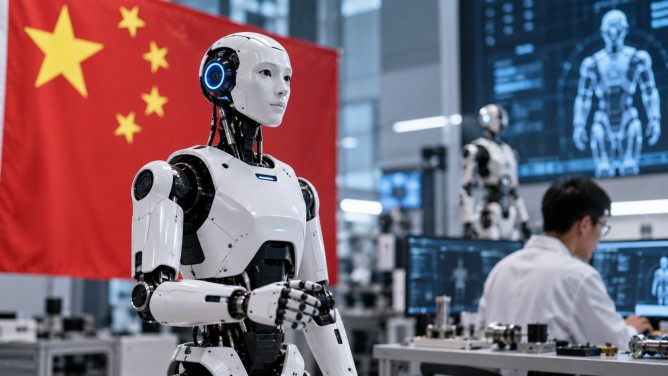
The humanoid robotics sector is on the brink of a significant evolution, driven by swift advancements in embodied intelligence, particularly within China. Recent global focus was directed at the World Humanoid Robot Games in Beijing, where Chinese-developed humanoid robots showcased extraordinary abilities in various sports events. Notably, some of these robots outperformed existing human records, including Usain Bolt’s 9.58-second 100-meter sprint and Wayde van Niekerk’s 43.03-second 400-meter record.
This rapid progress has heightened competition among Chinese robotics firms and professionals eager to lead this burgeoning industry. The progress has also sparked a pivotal debate: has the humanoid robotics field achieved its “iPhone moment”? This term, introduced in the AI sector by Nvidia CEO Jensen Huang in 2023, describes a major technological leap that transitions an innovation from a nascent idea to widespread adoption, fundamentally altering industries and user interactions.
Wang Xingxing, the founder and CEO of Unitree Robotics, a prominent Chinese humanoid robot producer, provided a measured perspective on when embodied intelligence might reach such a milestone. Speaking at the 2026 World Robot Conference in Beijing on August 20, he suggested that embodied intelligence might reach an industry tipping point akin to the ChatGPT breakthrough within two to three years, though this timeline could extend to five to ten years if development proceeds more slowly.
Wang’s insights were shared shortly after Unitree Robotics made its debut on the Shanghai Stock Exchange’s STAR Market, where its shares saw an impressive closing increase of 460 percent. This market debut underscores the burgeoning interest and investment in the humanoid robotics field, as stakeholders anticipate a transformative era driven by rapid technological advancements.