
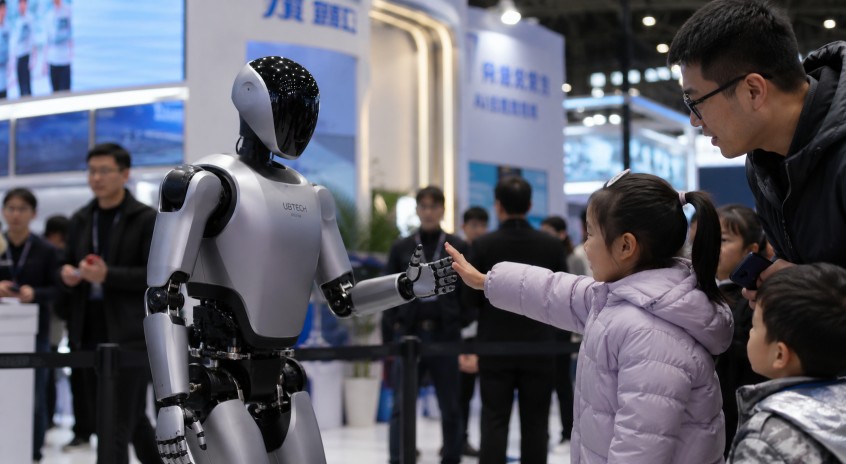
China’s robotics industry has experienced a significant evolution over the last 20 years, transitioning from basic, remote-controlled devices to sophisticated systems capable of independent decision-making and collaboration in real-world settings. The industry’s journey took off in 2007 with the creation of i-Sobot, a compact robot developed in Dongguan, Guangdong Province. Despite its small size, i-Sobot could execute approximately 240 different movements, including walking and climbing, marking an early achievement in China’s robotics advancements.
Originally an experimental innovation, the field of intelligent robotics in China has since burgeoned into a robust industry. Today’s Chinese robots are equipped with artificial intelligence, enabling them to understand their environment, make autonomous decisions, and collaborate with humans across diverse settings. This technological leap has propelled these machines from research laboratories to practical applications in manufacturing, logistics, healthcare, public services, and everyday life.
The deployment of these intelligent machines is part of China’s broader strategy to cultivate “new quality productive forces,” focusing on technological innovation, enhanced productivity, and high-quality industrial development. With such advancements, robots are increasingly integral to driving economic growth and improving efficiency across various sectors.
China’s rapid progress in robotics underscores its growing investment in advanced technologies and its determination to integrate intelligent automation into industry frameworks. As these machines become more prevalent, they are expected to play a crucial role in shaping future economic landscapes and enhancing everyday life.