
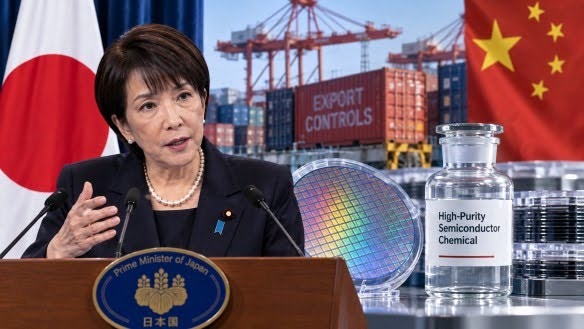
Japan has raised objections to China’s newly imposed export restrictions on dichlorosilane (DCS), a key chemical in semiconductor manufacturing, citing concerns over the influence on Japanese businesses. The fresh measures mandate Chinese importers of DCS from Japan to place cash deposits of up to 99.2%, a requirement that impacts major Japanese exporters such as Shin-Etsu Chemical and Denal Silane.
China has labeled these restrictions as provisional, following an anti-dumping investigation that concluded Japanese DCS exports adversely affected its domestic industry. A comprehensive decision is anticipated upon the conclusion of this investigation. In response, the Japanese government has urged China to avoid unfairly harming Japanese enterprises and has signaled its readiness to take suitable actions if required.
The introduction of these restrictions occurs amidst deteriorating diplomatic ties between China and Japan, particularly over Japan’s stance on Taiwan. This move is part of a broader pattern of trade and export limitations imposed by Beijing, targeting Japanese companies and products with dual-use capabilities that could have military applications.
DCS is instrumental in the semiconductor industry, where it is used to form ultra-thin layers of silicon and other materials on computer chips. Given Japan’s status as a leading global producer of ultrapure DCS, these new restrictions pose a significant challenge to the semiconductor supply chain.