
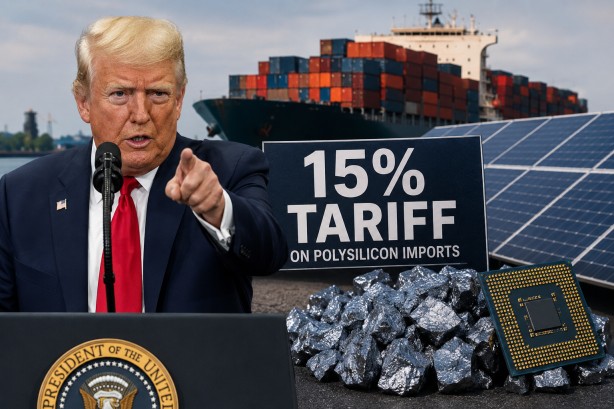
In a move to bolster domestic production and reduce dependence on China, US President Donald Trump has announced a 15% tariff on imported products made with polysilicon, effective December 4. Polysilicon, a critical component in the manufacturing of semiconductors and solar panels, is predominantly produced by China. The tariff is part of a broader strategy to enhance the US’s economic and national security by strengthening supply chains.
The tariff structure includes setting minimum import prices: $21 per kilogram for polysilicon, $100 per kilogram for polysilicon ingots and wafers, $0.22 per watt for solar cells, and $0.38 per watt for solar modules and panels. These measures are designed to make domestic polysilicon production more commercially viable, fostering a homegrown industry that can compete on a global scale.
Currently, the US hosts two major polysilicon production facilities operated by Hemlock Semiconductor in Michigan and Wacker Chemie in Tennessee. The new policy not only imposes tariffs but also permits the establishment of incentives for companies investing in US-based polysilicon and related manufacturing facilities. This dual approach aims to create a more robust domestic market and secure critical technology supply chains.
China, the world’s leading polysilicon producer, has criticized the US’s decision, suggesting that national security concerns are being misused to justify trade restrictions. Chinese officials warn that increasing protectionism could strain trade relations between the two countries. This comes amidst a period of strong growth in Chinese exports, particularly in electronics and high-value sectors like artificial intelligence.