
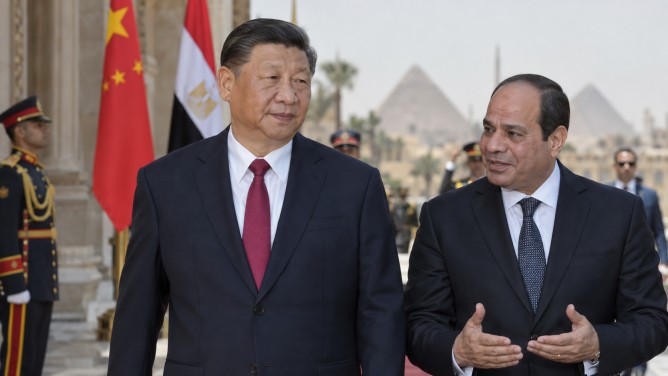
Chinese President Xi Jinping has put forth a proposal for a new security framework in the Middle East, emphasizing cooperation, dialogue, and respect for national sovereignty. This initiative was discussed during his meeting with Egyptian President Abdel Fattah El-Sisi in Cairo, where Xi outlined a four-point plan aimed at enhancing regional security cooperation, resolving interconnected conflicts, fostering economic development, and boosting international coordination.
Highlighting the need for regional countries to assume greater responsibility for their security, Xi voiced opposition to external interference. He underscored the significance of the Palestinian issue as central to addressing broader Middle Eastern tensions. Moreover, China expressed its readiness to collaborate with regional nations on safeguarding international shipping routes, promoting economic development, and tackling the root causes of conflict. Xi emphasized that the United Nations Charter and international law should continue to serve as the cornerstone for handling regional challenges.
Economic relations between China and Egypt were also a focal point of the talks. Xi advocated for enhanced cooperation in various sectors, including infrastructure, energy, agriculture, communications, electric vehicles, green energy, aerospace, and the digital economy. China has consistently been Egypt’s largest trading partner and primary source of imports for 14 consecutive years. The bilateral trade volume increased from $10.21 billion in 2013 to $20.79 billion in 2025.
The two nations signed over 20 cooperation agreements covering diverse areas such as artificial intelligence, trade, technology, education, transportation, and industrial supply chains. Additionally, they released a joint statement aimed at further strengthening their comprehensive strategic partnership, signaling a commitment to deepening bilateral ties across multiple domains.